
Sources of Our Anger
Lisa Lee discusses the toll a family’s anger takes in American Han.
By Lisa Locascio Nighthawk
Napa-raised Lisa Lee’s debut novel, American Han, is narrated by Jane Kim, the daughter of Korean immigrants, who grew up in northern California in the 1980s and ’90s, alongside her brother, Kevin. As young adults, Kevin and Jane find themselves–and their family relationships–in crisis against a backdrop of a rapidly changing California, where their parents’ years of striving for the American dream meet a desultory wake-up call. Brutally funny, surreal, and honest, the novel is unflinching in its portrayal of how a lifetime of alienation and prejudice impact a nuclear family isolated by the very values they seek to embody.
For Lee, a writer and teacher who completed her book over the course of a decade while raising her daughter and completing a PhD at the University of Southern California, American Han is both a homecoming and a long-awaited catharsis. “I just spent so much time trying not to write about being from Napa, not to write about characters that seemed like they could be members of my family, ” she said of the book during our interview, which was conducted at her South Pasadena home. “Finally I had to give myself permission to write about the world I grew up in.”
This interview has been edited for brevity and clarity.
American Han operates on many levels: it's about the Kim family, and it’s also about the end of housing accessibility in the Bay Area. It is elegiac, but Jane is furious–at her parents and at the world–and your novel shows how her anger helps her survive and change her life. Can you talk about where the book’s title comes from, about the concept of han, for readers who may be unfamiliar with it?
In grad school [at USC], Viet [Thanh Nguyen, Lee’s advisor] sent me an article about han. I thought I was learning a new concept, but I realized that I already knew about han. I had forgotten it, and now I was remembering and relearning it.
Ethnic Studies professor Elaine Kim’s definition was the first one I read: “the sorrow and anger that grow from accumulated experiences of oppression,” which refers to the centuries of war and trauma and national division in Korea. And then there's another, from a journalist, [Jay Caspian Kang], who called it “a state of hopeless, crippling sadness combined with anger at an unjust world.” I think those definitions are very accurate, but I would add my own: a feeling of helplessness and a feeling of entrapment and a feeling that you could explode at any moment.
I heard han being talked about in hushed tones when I was growing up, oh, he has han. He's bad. He's too Korean. I remember hearing that a lot about my dad. Sometimes a Korean person or an aunt would accuse me of having han, and it was always meant as an insult. Everybody is always saying that you're so American, but you're not because you have han. You got it from your dad. So I already knew about it and I already knew what it meant. It's just nobody had ever talked about it except to use it as an insult.
People in Korea now think that han is a thing of the past, that it doesn't exist anymore and hasn't existed since, like, the late 1990s. This was actually something that was sort of yelled at me at a conference in Seoul about 10 years ago. I'm not trying to say I understand the modern Korean psyche. But when Koreans from my parents' generation immigrated in the late 1960s, they brought han with them and passed it down to their children. That han got combined with American racism and changed because of the pressure to assimilate, which includes the pressure to forget about the past. And it became this new form. It's not Korean han anymore. It's American han.
Edward P Jones famously said that he writes about his hometown of Washington D.C. because it’s what's accessible to him, because he's lived there his whole life. Napa feels similarly lived-in and intimately captured in your novel. You recently went back to Napa for the first time in twenty years.
I went back because there's a really big concert grand piano there. My mom has stubbornly held onto it and moved it around as she’s moved. She really wanted to keep it for me, even though currently it takes up her entire living room. Several years ago, I realized I’m never going to play it again. I have carpal tunnel, my daughter doesn't want to learn, I’ll never have space for it. But my mom has held on to it for so long. My car is twenty years old and it’s falling apart. I went to Napa to take pictures of the piano, hoping I could sell it and get myself a new used car. And that hasn't worked out.
But another thing that happened when I was home was that my mom gave me her entire collection of jewelry. I think she felt like she might get dementia because her mom did. When my grandma got sick, my mom and all her sisters flew to Korea at different times to help take care of her. While they were there, they took all the jewelry they could get their hands on, because as women they weren't going to inherit anything. Everything was going to go to their brothers. So my mom, fearing that she might get swindled in her old age just as her mother was, just gave it all to me, and now I'm like a pirate with all this antique gold jewelry and gems.
That's resonant with the book too, the brutal sexist logic of primogeniture. Did you feel like you discovered anything by writing this book?
I think I wrote the book to understand the anger I felt in myself and that I saw in my family and others. I wanted to understand the sources of our anger.
You said that you grew up surrounded by anger but felt judged for being angry. Where do you think your family’s anger came from?
My parents owned and ran small businesses, which can be a very unstable way of making a living. Their biggest stress was money. They always felt short on money and never knew how much would be coming in. Our town was very white and insular and conservative, a completely different planet from the nearest major city (San Francisco). Whiteness granted privilege. A lot of our anger comes from the way we were treated.
Do you think the same thing changed for you?
Just being able to do what you want with your life can make you much less angry. I’m still angry, but I no longer feel powerless, which is how I used to feel. It took a long time to get here, and I had to ignore a whole lot of people telling me I was crazy to leave a law career, that I’d never make it as a writer. If I’d listened to them I’m sure I’d be a lot more financially comfortable now, but I think I’d be more angry. Whenever I’ve felt overwhelmed by anger in my life, it’s because I’ve felt stuck in a life I didn’t choose. The career I’m working on now has often been a struggle, and still is in many ways, but it’s a struggle I chose for myself.
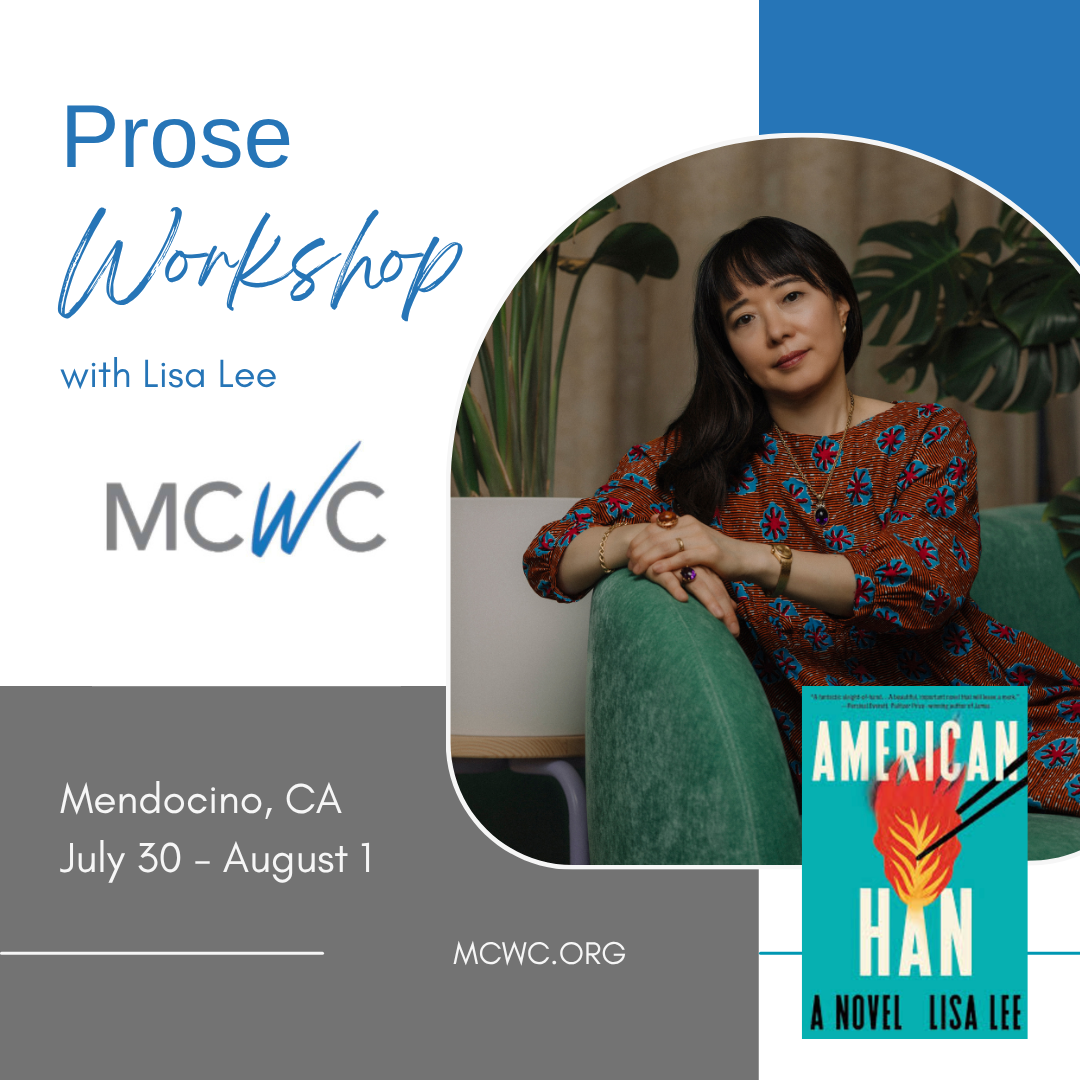
Lisa Lee is teaching our multi-genre prose workshop this summer at 2026 MCWC. Learn more and register here!