
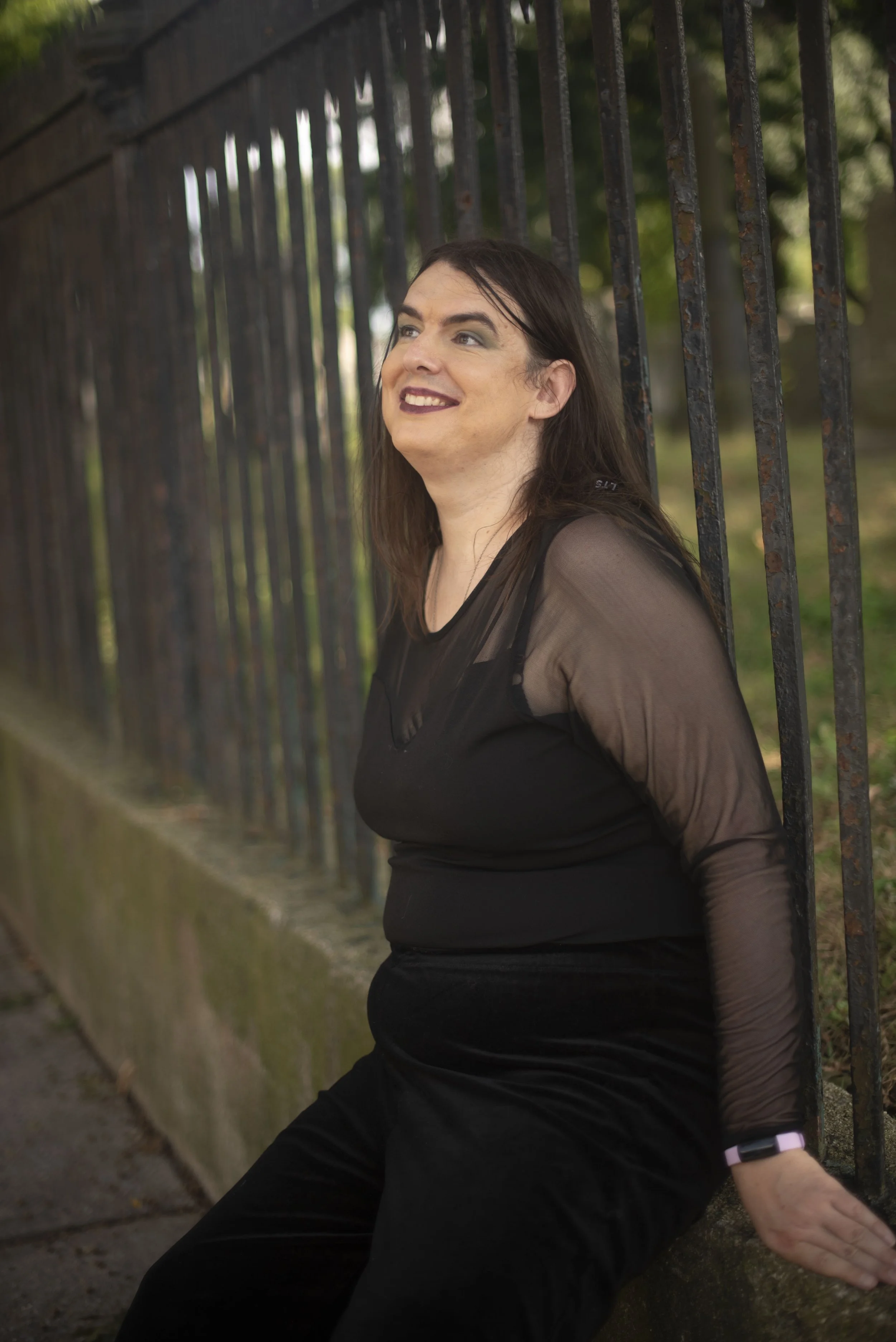
Lisa Locascio Nighthawk, Executive Director at MCWC, was thrilled at the opportunity to ask Jeanne Thornton, one of the recipients of the Judith A Markowitz Emerging Writers Award, as well as a Lambda Literary Fellow and the winner of the Lambda Literary Award for Trans Fiction in 2021, a few questions ahead of our 2026 MCWC conference.
How would you introduce yourself and your practice as a writer to someone encountering your work for the first time?
I’m a trans woman writer, and part of my project is always going to be thinking about how to articulate what transfeminine experience feels like to myself in a way that I hope is also useful to other trans writers (and cis ones too).
I’m interested in POV and the question of what a text “is”—like when you’re reading a novel, what is it that you’re reading, other than a bunch of words arranged so as to make money? Some of my books take the form of letters or IRC chats or space zines; my next big project is a comic book in part because I love comics but in part because comics are in some ways the Ultimate Third Person POV (except: are they?)
I’m interested in trying to communicate something about what compels me in my own obsessions. In various work published or forthcoming, this has been Star Trek, the Beach Boys, teenage computer game making communities, exoplanets and terraforming, the links between therapy and magic, dance and movement, animal communication. Or things that are less outside too: how you heal from abuse and desist from abusing, how you exist ethically with other people.
I’m interested in how a narrative project changes over a lifetime: how are the things I wrote when I was 25 in continuity with the things I’m writing today, or that I’ll write, God willing, in 25 years? I’m fascinated with this in all writers, which is something I think has helped me be an editor, but this question is something I try to be intentional about with every Big Writing Project.
Finally, I’m interested in writing about a certain kind of loneliness and in characters who make efforts, however successful or unsuccessful, to connect beyond it.
Your MCWC 2026 Master Class is called “World and Objects in Narrative,” and in your description, you write: “a story's setting and its key objects are a crucial part of a narrative's weave--and often, when we're blocked in progress, it's because we have further to go on our journey to imagine those worlds.” Is this an insight you gained from an experience with your own work, or reading the work of others? Is there a story/stories here (about a reading or writing experience) you could share?
Very much something I’ve gained from my own experience, and one I’ve seen in other people’s writing as well sometimes as an editor!
It’s also something I’ve gleaned from trying to get better at drawing. One of my favorite pieces of pedagogy is Kimon Nicolaides’s The Natural Way to Draw, which starts with exercises designed to connect your drawing hand to the tactile sense in your brain: as you draw a line, imagine how it would feel to touch the thing you’re drawing; as you’re shading, imagine yourself pushing or pulling the figure in or out of the frame; as you’re building up forms, imagine yourself feeling their weight. If you can really believe that you’re touching the things you draw, you can stay in the flow state that lets you keep drawing.
I think there’s something parallel with writing: if you’re blocked in a drawing, maybe you need to find a new way of looking at the subject; if you’re blocked in a story, maybe you need to imagine more of it. I’ve tried to collect and sometimes design different writing exercises over the years with the goal of helping writers build up that tactile sense; I’m excited to share some of these.
In your workshop description you name "the deck of the Pequod, the dead blue sitting-rooms, jewel chests, and burning wills of Middlemarch, the quicksand and glass mansions of the Isle de Chevaliers, the stone labyrinths of Earthsea” as examples of worlds and objects from literature. Are there any other favorites (and/or notables) that come to mind? Examples of ineffective worlds and objects are also welcome here.
I often teach these examples because I love them! But I think you can at least in principle do this with any narrative. One of the really influential books I read in my English undergraduate days was Nabokov’s Lectures on Literature, which has this idiosyncratic method: in order to understand a text, begin by making maps and drawings of the spaces within it. I think if that isn’t interesting to do when you look at a story, you may be in trouble. It doesn’t even have to be a particularly complicated world: one of my favorite little narratives is Beckett’s play Ohio Impromptu, whose narrative world is a single table with two identical men, one of whom never speaks, and a book that contains every other narrative fact about the world. And the entire action of the play is one man reading the world to the other.
The only ineffective world I think is the one you haven’t completely imagined, and part of their ineffectiveness is that it’s hard to remember any of these well.
You are an author of fiction, creative nonfiction, and comics, as well as an editor at Feminist Press and Instar Books. How do these roles work together, and how do they influence your practice as a teacher?
One of my favorite quotes is from Roberto Calasso, to the effect that publishing is a kind of “writing by collage.” I love being an acquiring editor and stitching together these narrative quilts out of books and subjects I’d never be able to write, but that I’m fascinated by, and that I think can become part of this big multi-part story that places like Feminist Press, Instar Books, or any publisher are telling over time about what literature is or could be. I’ve been at Feminist Press for a year and a half now, and I keep being fascinated to look at the books in the company library, which goes back to 1970, and think about how all the different seasons of a publishing company add up to this whole multi-part story that everyone who’s worked at the Press over the years has been involved in building.
I think one of my main jobs as a teacher is never to forget what it feels like not to know how to do something, and to find as many ways as possible into it. Being an editor and working with lots of different writers, and reading lots of different manuscripts, helps keep that muscle very active; so does jumping between genres and trying to find ways to “translate” things you know how to do in one into another. (See my answer about Kimon Nicolaides above.)
What’s the best and/or worst (pick one, or better, both!) piece of writing advice you’ve ever received?
The best is to trust your instincts and to check in every so often with why you’re actually writing something—it’s surprising how easy it is not to do this, and how much it clarifies things to try to think through this. The worst advice is probably to tailor your writing to any specific audience or reader. If you’re thinking when you write about “what editors will buy” or whatever, I can tell you as an editor that you are not in touch with the thing that editors will actually buy, which is your honest and unique experience of the world. It is not as if we can’t tell this!
What is a question you have always wanted to be asked in an interview? Ask and answer it here.
I don’t think I’ve ever thought about this! Maybe the Spock question from Star Trek IV, where the computer asks him how he feels. But I do not think I should answer this.
Applications to our 2026 conference scholarships and to our juried-in Master Class are now open! The deadline to apply is 11:59 p.m. PT on Saturday, February 28, 2026. Learn more and apply here.